
Sorry for the delay in creating content and blogging. I am back in school and finishing up my second term as a doctoral student. I am loving every minute of it! For the final assignment for the course, I have been asked to write a blog reflecting on my experience in the course, the graphic organizers I have created, and the quantitative and qualitative studies I have read about and produced myself. Fortunately, I already have a blog!
Here are my top 5 takeaways from the course:
Invitational learning allows for positive connections and culture.
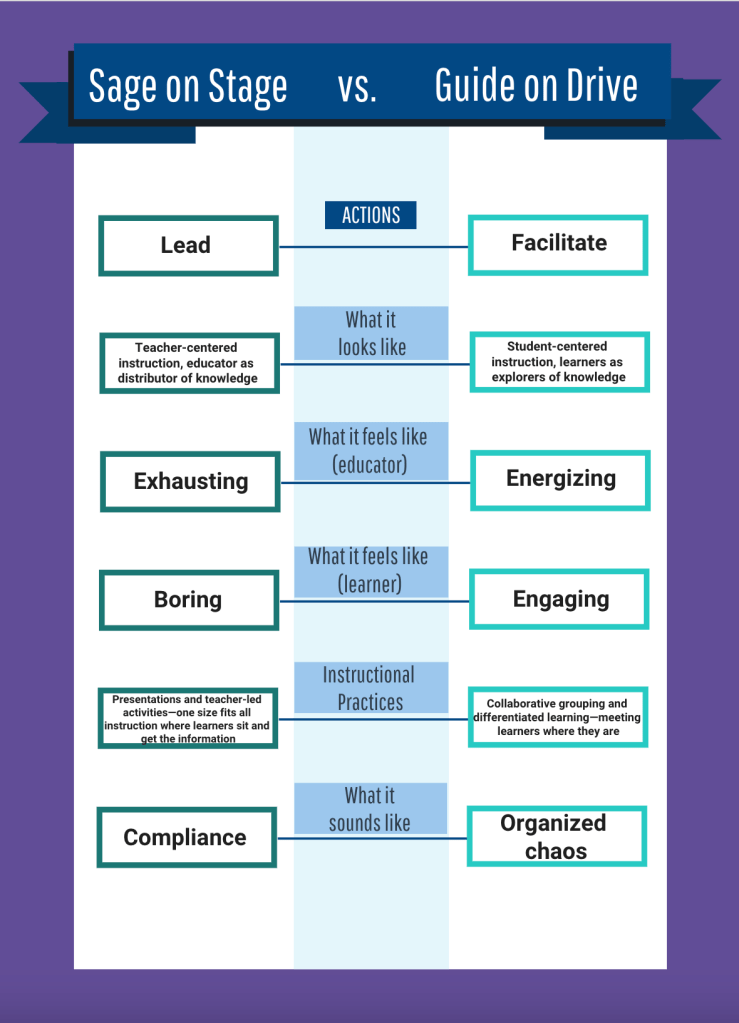
We know that a strong climate and culture are a must for learner success. Creating a positive climate and culture starts with positively using your words. Invitational learning not only has a beautiful ring to it but also sends the message to learners that learning is their choice, and we are inviting them to be a part of this discovery of knowledge. Invitational learning focuses on the whole child, paying attention to their academic achievement and personal potential (Ford, 2015). So, how do we do this? We must make sure that learners feel valued and appreciated as learners through a variety of equitable strategies, consistently. Ford, 2015, posits that the principles of invitational learning revolve around respect, trust, optimism, and intentionality. Are you using Wiggins and McTighe’s objective questions? This ensures that there is intentionality in every lesson. When we respect and trust our learners, we become less of the “sage on stage” (King, 1993) and more of the guide on the drive. This allows learners to have more autonomy in their learning, and it shows learners that we value them as a part of the journey towards knowledge acquisition.
Multimodal instructional strategies are imperative for all age groups of learners.
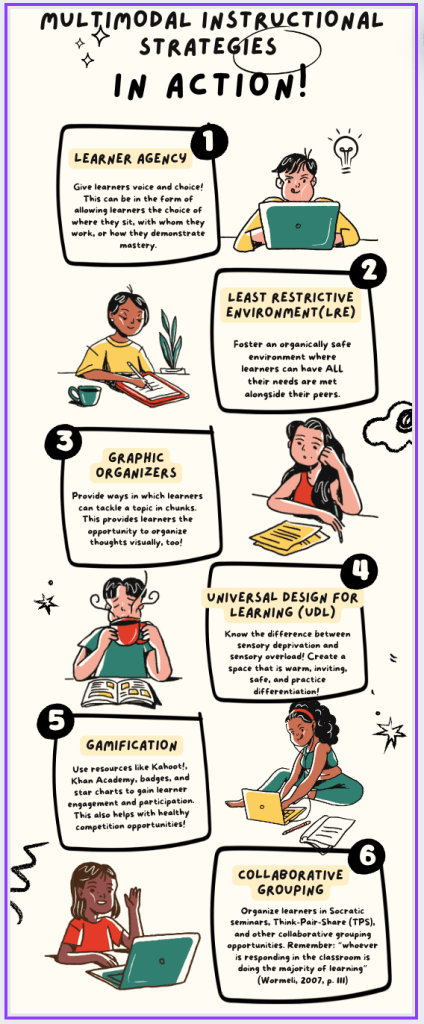
I did a mixed-methods study on using multimodal instructional strategies in the classroom. I used ten high school educators from different schools and states to gather the data. These educators were given an anonymous survey with eight Likert-scale questions and four open-ended questions. Multimodal instructional strategies are research-based best practices that need to exist in the learning environment to accommodate and engage every learner. Unfortunately, what I learned is that aside from graphic organizers and collaborative grouping, very few other multimodal strategies were incorporated at the high school level. Strategies such as gamification (Kahoot!, Khan Academy, etc.), learner agency, Socratic seminars, and Universal Design for Learning (UDL) were either not used at all, or unknown. Learners, regardless of age or grade level, benefit from these research-based strategies. If you’re not using them, please start!
Rules and procedures: Keep them short, keep them positive, and remember to focus on respect.
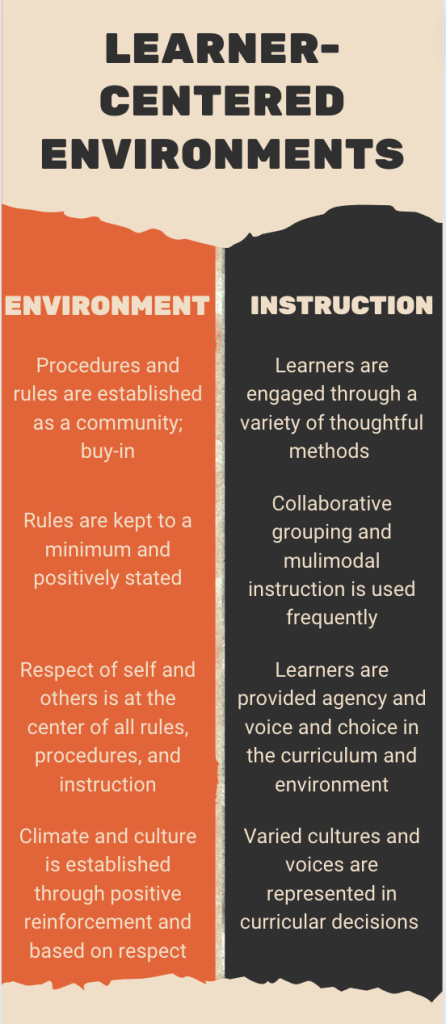
In my interview with a 17-year veteran high school English educator, I gained some important insights as to what is most valuable in creating learner-centered environments and what this looks like in terms of both instruction and the physical space. Through this 30-minute interview and qualitative study, the educator informed me of how she, with the help of her learners, has created four rules for the classroom. While a couple of rules focus on policies and procedures, all are positively stated (come to class on time and prepared to learn vs. don’t be late) and have to do with respect for yourself and others. The educator went into detail about what she does to create a warm and supportive environment from the first day of class and what this looks like instructionally and physically. This image details the main findings from the discussion. From the varied lessons and multimodal strategies used, it is clear that this educator understands that every learner is unique and that diverse perspectives and culturally inclusive instruction take place daily. Appreciating learners for who they are and where they are is the key to her success and, quite importantly, the learners’ success.
Maintain high expectations for everyone, even yourself.
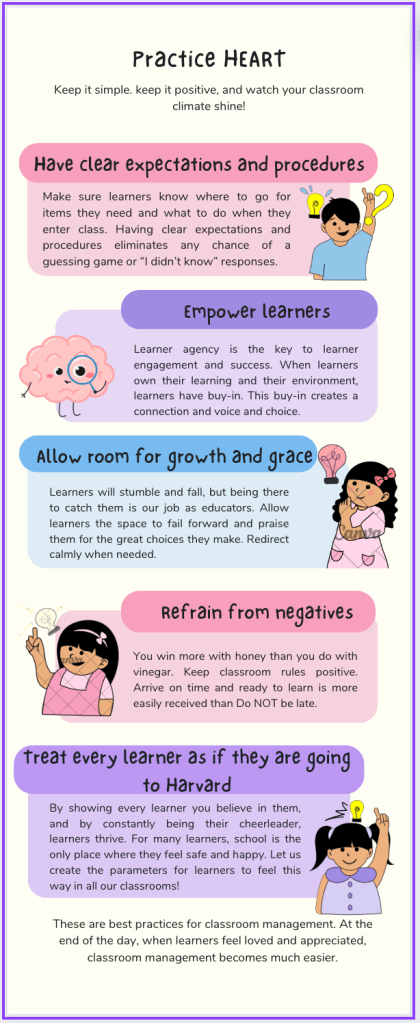
Sometimes, it is hard to consider the ramifications of our actions, especially when we think we are helping. Holding learners to different expectations is one such action that has a detrimental effect on them. Gershenson and Papageorge (2018) discuss how our expectations for learners have a significant impact on college completion rates, attainment rates, and learner self-perception and performance. This is why it’s so important to treat every learner as if they are going to Harvard (the HEART® acronym from a previous blog). Learners who feel encouraged and supported, through consistently high expectations, are more likely to succeed.
It is important to check yourself as an educator, too. Are you creating a challenging and warm environment where learners feel like they can succeed? Do you hold yourself to high expectations, regardless of how many years you’ve been teaching? Do you seek professional development and opportunities to learn new information? Are you finding innovative ways to teach content every year to ensure you’re preparing learners to be ready for their future? If we stop challenging ourselves, and keeping expectations for ourselves high, how can we expect our learners to rise to the occasion? How you answer these questions is important to reflect on.
Technology is a necessary evil; know how and when to use it appropriately.
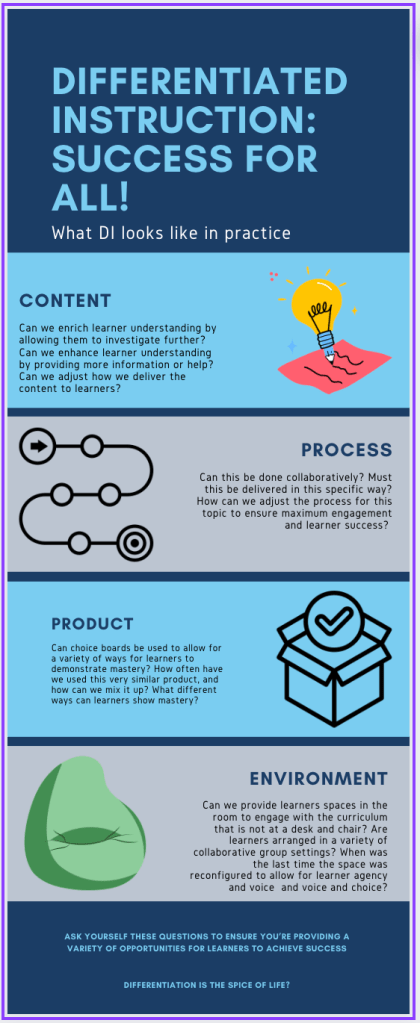
While Tomlinson (1999) came before the surge in technology, her merit for understanding differentiation is still important for the learning environment. Ultimately, differentiation is the focal point of successful instruction. Incorporating technology to differentiate instruction and provide personalized learning opportunities is one such way. Our learners today are “digital natives” (Weinstein, 2016). This means we need to create opportunities for learners to utilize technology when participating in authentic learning opportunities. For some of us, we grew up in a time when social media didn’t come out until we were in college (or after it), and we used the card catalog and actual books to complete our research. My niece, who was three at the time, grabbed my hand once (I thought to hold it) so that she could get my fingerprint to open my phone. These are today’s learners, and we need to arm them with the tools they need to succeed and teach them how to navigate these tools and use them correctly. While AI and ChatGPT can be great resources, shame on us if we do not teach learners to use them as a resource and not the ultimate solution. Also, we need to know how to detect when learners are using it as the ultimate solution and redirect and coach learners through this. Using technology to allow for differentiation and for learners to engage in their learning is paramount. However, it is important to remember that there is a time and place for technology. Learners still need to work collaboratively and interact with their peers. They need real-life face time even more than they need screen time. Creating an environment rich in differentiated materials and content will lead to an environment rich in engagement.
Hopefully, these resources are helpful. The next blog will dig deeper into preparing learners best for their futures in every aspect- including standardized assessment.
 Edukater's Corner