
When I decided to become a teacher, it wasn’t because I wanted summers off (I worked in the summer). It wasn’t because I wanted to be just like one of my teachers. It wasn’t because I loved school. I did well at school. I made good grades, I was in theatre, president or vice president of ten different clubs, homecoming queen, an overachiever and people pleaser. School was easy for me, but I was often very bored. I had great teachers- exceptional educators whom I adored. Economics was the hardest class I ever took, but Mr. Noto made it entertaining. Ms. Bogart helped get me through proofs so I could be in the musical. Dr. Smith, and Dr. Reynolds helped nurture my love of science. Mr. Morris held class in a round table format (the only class where we didn’t sit in desks in rows) where we all discussed current events. I babysat Mrs. Cappossere’s children. Mr. Maxwell, one of the most tremendous humans I’ve ever known, and the epitome of great leadership, as an administrator, held the door open every morning, rain or shine, and greeted us into the halls of Brighton High School.
I loved (love) learning, but aside from all my social activities, school was just something to do. When I started college, I had to take an English elective course. I chose creative writing. I had geology and chemistry for consumers, in lecture halls, before the evening class in a classroom style setting. The professor strolled in- she looked like Professor Trelawny from Harry Potter. With her scarves and skirts billowing behind her and her jingling jewelry, I was mesmerized. Reading and critiquing, and writing finally came to life. We sat on the floor in her class. We met outside on nice days. We discussed, and she challenged what we thought without ever giving her opinion. This professor was brilliant. I wanted to bring these things to life for my learners, and I vowed to do just that.
Through my teaching program, I sat in developmental psychology, cultural and linguistic diversity, teaching in the middle school, lit and tech, and a number of other education courses, in lecture halls. We signed in, we sat down, and we learned about theory. We got the information. We took the test. We wrote the papers. Then, we student taught in classrooms with educators who had gone through the same program and learned the same theory- but very rarely did they have the chance to experience it in action. Lecture halls do not allow, and are not constructed, for that type of learning.
It wasn’t until I got my first classroom that I finally got the chance to do things “my way”. I didn’t want learners to feel the way I had in school. I got my master’s degree in differentiated instruction and gifted education, and by golly, I was going to have a differentiated classroom where all learners’ giftedness was going to shine! I had desks that were attached to the chairs. But they were always rearranged. I put bedrisers on desks to make standing desks. I had a butterfly chair and a beanbag (which always exploded). I commandeered music stands that weren’t being used to create floor or standing desks. I decorated the walls in Twilight and Harry Potter or whatever else was in that year, and I read them. I loved my precious gems, and I respected them as learners. I encouraged them to question, I went to their activities outside of the classroom, I chaperoned spectator buses, and I let them stay in my room after school to work. At the end of the year, they passed, and they moved on. But, I still get invited to their weddings, I still talk to them when they chaperone their class trips down to Florida as educators themselves, and I am still connected with them.
None of this was learned from my formal education. Lecture halls do not teach connectivity or collaboration. Attendance through a clicker does not create a lasting bond with a learner. All the theory in the world does not substitute learning it in action. If we are to truly prepare future educators for their role, we need to change the way we teach them. We teach the way we are taught to teach. It is not a bad thing, we just need to change the way we teach these future educators. It might mean smaller class sizes and additional sections. It might mean changing time or day options. To not change because of that inconvenience, well, what purpose are we serving- who are we serving? Are we truly serving?
We are experiencing a time where educators are leaving the profession in droves. The sad reality is that a third of teachers leave the field after five years of qualifying to teach. Yes, continuing professional development is critical, but not leaving the education program with the tools to get started is another reason for this burnout. There is a lot of pressure on educators to accommodate the learning loss from the pandemic. Mental health issues are on the rise, and the need for engagement, involvement, and inclusion has never been more paramount. Twenty-five desks and chairs and a “teacher fortress”, the same for everyone, will not cut it anymore. But, if educators are not respected, and educators are not equipped with the tools they need on how to create a warm and calm environment for their learners, they may end up frustrated and dejected and leave.
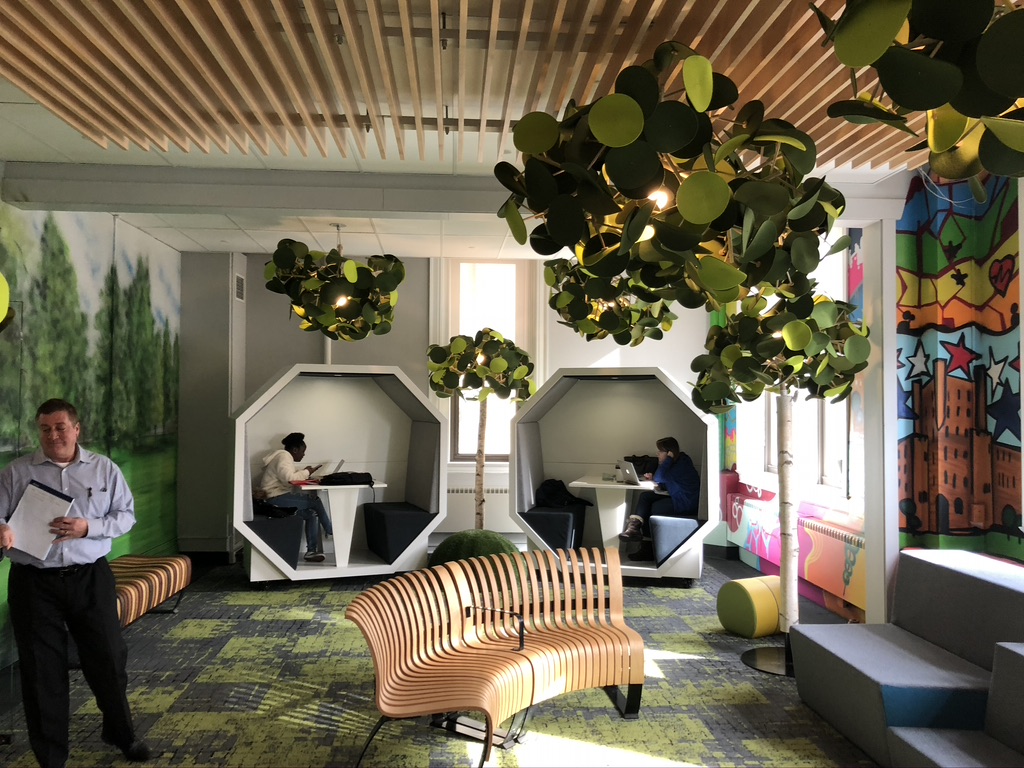
Universities like D’Youville University in Buffalo, New York and the University of Central Florida have started to reimagine their campus life for students. These directors understand the importance of putting theory to practice. Creating collaborative and engaging environments, where they teach differentiated instruction in a differentiated environment, allows these future educators to see the type of environment- not desks in rows- that they could have in their own classroom.
We are no longer preparing learners for automated jobs- the Ford assembly line is run by computers and machines. Desks in rows have a time and a place, but if we are truly creating future-ready schools and preparing learners for their future, our classrooms and the way we prepare our educators needs to change. The fact that lecture halls on ivy league campuses look the same as they did in the 1800’s should be the first indicator that things need to be reimagined. If our classrooms look the same as the 1800’s, how can we truly say that we’re preparing learners for their future in an antiquated system?
 Edukater's Corner