
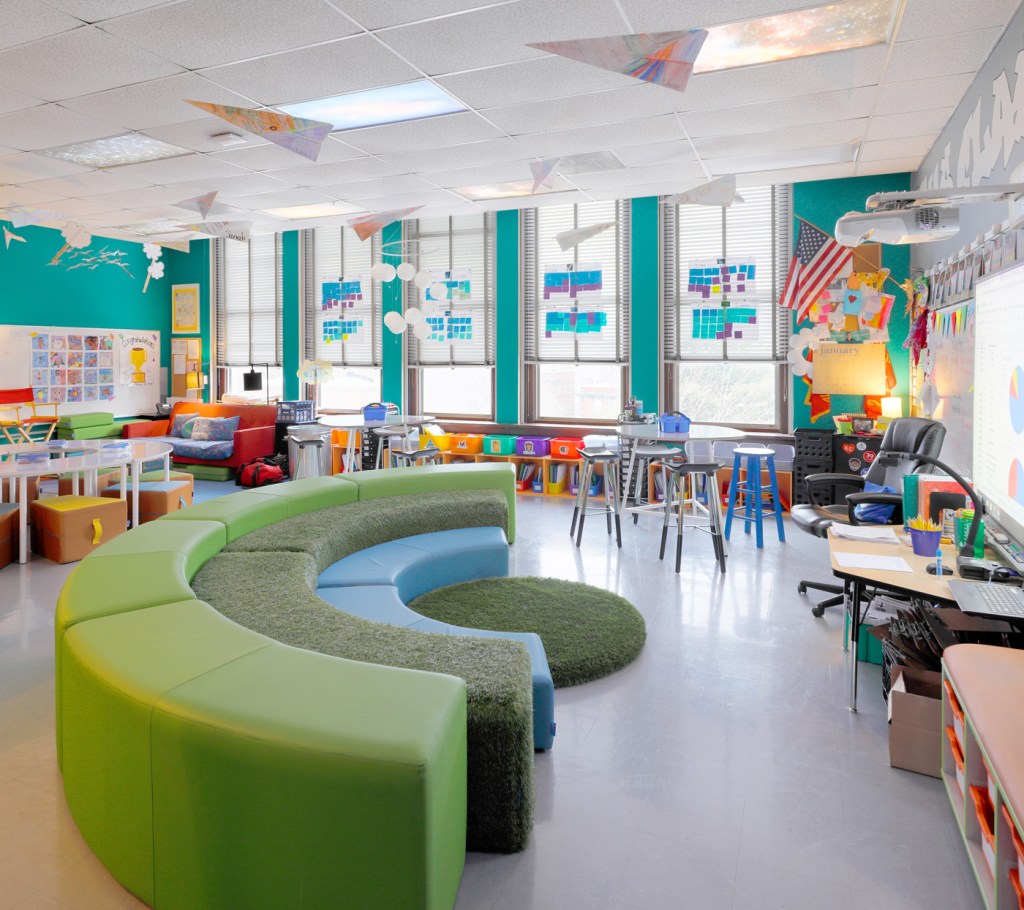
The massive “push” and “buzzword” right now is the focus on wellness and calming spaces. While it is evident that it is essential for learners to feel safe and emotionally supported, and that these fundamental needs must be addressed, every space should be a wellness and calming space. With everything going on globally, the world of education has shifted tremendously. As learners are going back to physical schools after time away from the classroom and dealing with virtual learning, social and emotional well-being is at the forefront of everyone’s mind.
The Individuals with Disabilities Education Act (IDEA,1997) focused on leaning towards the push in model for education. This became important when it was understood that learner needs should be met without the stigmatization of being pulled out of the classroom. Pulling a learner out of the classroom led to loss of instructional time. It also meant that learner needs weren’t being met in the general education classroom. In the grand scheme of things, this doesn’t seem that long ago, and we’ve come a long way in education over the past twenty-five years.
Wellness and calming spaces are well-intentioned. However, they take the learner out of the learning environment, meaning loss of instructional time, and this can cause a negative stigma for the learner. Not to mention, most of these spaces do not have a mental health professional, or any educator, to monitor, supervise, or address the deeper needs of the learner. How do these spaces address the social and emotional wellness of the learners? How do these spaces provide strategies and coping methods to deal with stress, anxiety, thoughts of depression, or any other situation with which a learner may be dealing?
Social and Emotional Learning (SEL) is an essential component to today’s curriculum. Ten to twenty percent of children and adolescents have a mental health problem of some type (Binagwaho, 2021). With fifty percent of all lifetime mental illness cases beginning at age 14 (nami.org), positive mental health is imperative to the ecosystem of schools across the country-especially in light of what’s happened over the past few years. What does this mean for schools and classrooms? The social and emotional needs of all learners, equally as important as their educational needs, should be addressed in the classroom. Understandably, addressing social and emotional needs in the classroom, with twenty-five plus learners, can feel daunting. With access to ESSR funds and resources that promote mental health awareness, now is the time to reevaluate the classroom.
While educators are parents, mentors, friends, conselors, magicians, and wizards in the classroom, and they transition between the roles seamlessly, they need support and resources. One way to address this is through the learning environment. In the book, The Third Teacher, the focus is around how the learning environment is a key contributor to learner success- it actually is one of the teachers.
How can we fix the learning environment to make it a calm, welcoming, and safe space? How can we make the learning environment a part of addressing social and emotional well-being? There’s no simple formula, but there are a few easy tweaks that can be made to ensure a functional and inclusive environment exists.
Reduce Noise
Classrooms can sometimes feel like a doctor’s office. White paint. White tiles. Glaring overhead fluorescent lights. Cold and sterile. Other times, they’re as overstimulating as a Chuck-E-Cheese. Whether this is in the form of visual or auditory, noise reduction is essential to learners feeling safe and calm. Pay attention to colors. Soft blue and green hues are more appealing for a calm atmosphere than black, red, and orange hues. Overhead fluorescent lights can sometimes flicker and buzz. This visual noise can have a major impact on mood. A pediatric research study found that by changing the lighting to LED blue hue lighting, learners were more focused and calmer (Morrow & Kanakri, 2018). Putting track lighting and lamps around the room is another way to make the classroom space more inviting. In an active learning environment, where the focus is on collaboration, the classroom can get loud. Adding acoustic tiles to the space can serve as a to buffer the noise levels. Acoustic tiles are usually Velcro receptive, too, which allows for them to serve a multifunctional purpose as a collaboration space or a display wall.
Bring the Outside In
Seasonal depression is a real thing. The lack of sunlight and fresh air can make people feel tired and moody. Based on a study conducted at the Harvard Decision Science Lab, spaces that bring plants and elements of nature into the design help to reduce stress and anxiety (Yin, 2018). Even if bringing actual plants into the space isn’t possible, natural lighting, instead of overhead lighting, can also serve this function. “Viewing peaceful natural environments has been shown to restore cognitive abilities and reduce physiological arousal…and higher end of semester grades” (Benfield, 2015). For windowless classrooms (thought to be best in order to eliminate distractions), adding texture and/or painting an accent wall could do the trick. A textured wall, textured, removable wallpaper, or a soft lilac paint could brighten up an entire space with very little funding necessary.
Give Learners Agency
Learners are no longer being prepared for the Ford assembly line. The “sit and get” method does not hold true in today’s classroom. Learners will be entering a workforce where transitional skills (AKA the 4 C’s: Communication, Collaboration, Creativity, Critical Thinking, etc.) are necessary. These are not skills that can be easily taught with all desks facing towards the front of a room. Furthermore, these skills are paramount to ensuring a learner’s healthy social and emotional development. One of the best (and often most terrifying) things about being an educator today is that the role is no longer the “sage on stage,” but rather, the “guide on the drive.” As the guide, it is important to offer variability in the space and allow learners to choose how they work best. This does not mean that everything in the classroom needs to be on casters or be height adjustable. Rather, this means offering different options for learners to sit on the floor, stand and work, or actively learn by sitting on something that allows them to wiggle and wobble a bit. Simply adding bed risers to a table or cutting down legs on a desk and putting pillows on the floor provides options and opportunities that did not exist before.
As Edward Everett Hale says best, “I cannot do everything, but I can do something. And I will not let what I cannot do interfere with what I can do.” Educators and schools are the epitomai of this statement. While budgets and funding may not get everything on the wish list, it can get something. And all small somethings add up to really big things when learners feel safe, acknowledged, and loved. Every space in a school needs to be a space where learners feel safe, acknowledged, and loved. To do so, every space needs to be a wellness/calming space in the school.
References:
Benfield, J. A.; Rainbolt, G. N.; Bell, P. A.; Donovan, G. H. 2015. Classrooms with nature views: Evidence of differing student perceptions and behaviors. Environment and Behavior. 47(2): 140-157.
Binagwaho A, Senga J. Children and Adolescent Mental Health in a Time of COVID-19: A Forgotten Priority. Ann Glob Health. 2021 Jun 29;87(1):57. doi: 10.5334/aogh.3330. PMID: 34249619; PMCID: PMC8252973.
Mental health conditions. NAMI. (2022). Retrieved September 12, 2022, from https://www.nami.org/about-mental-illness/mental-health-conditions#:~:text=50%25%20of%20all%20lifetime%20mental,and%2075%25%20by%20age%2024
Morrow, Brenda & Kanakri, Shireen. (2018). The impact of fluorescent and led lighting on students attitudes and behavior in the classroom. 10.24105/apr.2018.5.15.
OWP/P Architects, VS Furniture, & Bruce Mau Design. (2010). The third teacher: 79 ways you can use design to transform teaching & learning. Abrams, the art of books.
Yin, J., Zhu, S., MacNaughton, P., Allen, J. G., & Spengler, J. D. (2018). Physiological and cognitive performance of exposure to biophilic indoor environment. Building and Environment, 132, 255–262. https://doi.org/10.1016/j.buildenv.2018.01.006
 Edukater's Corner